
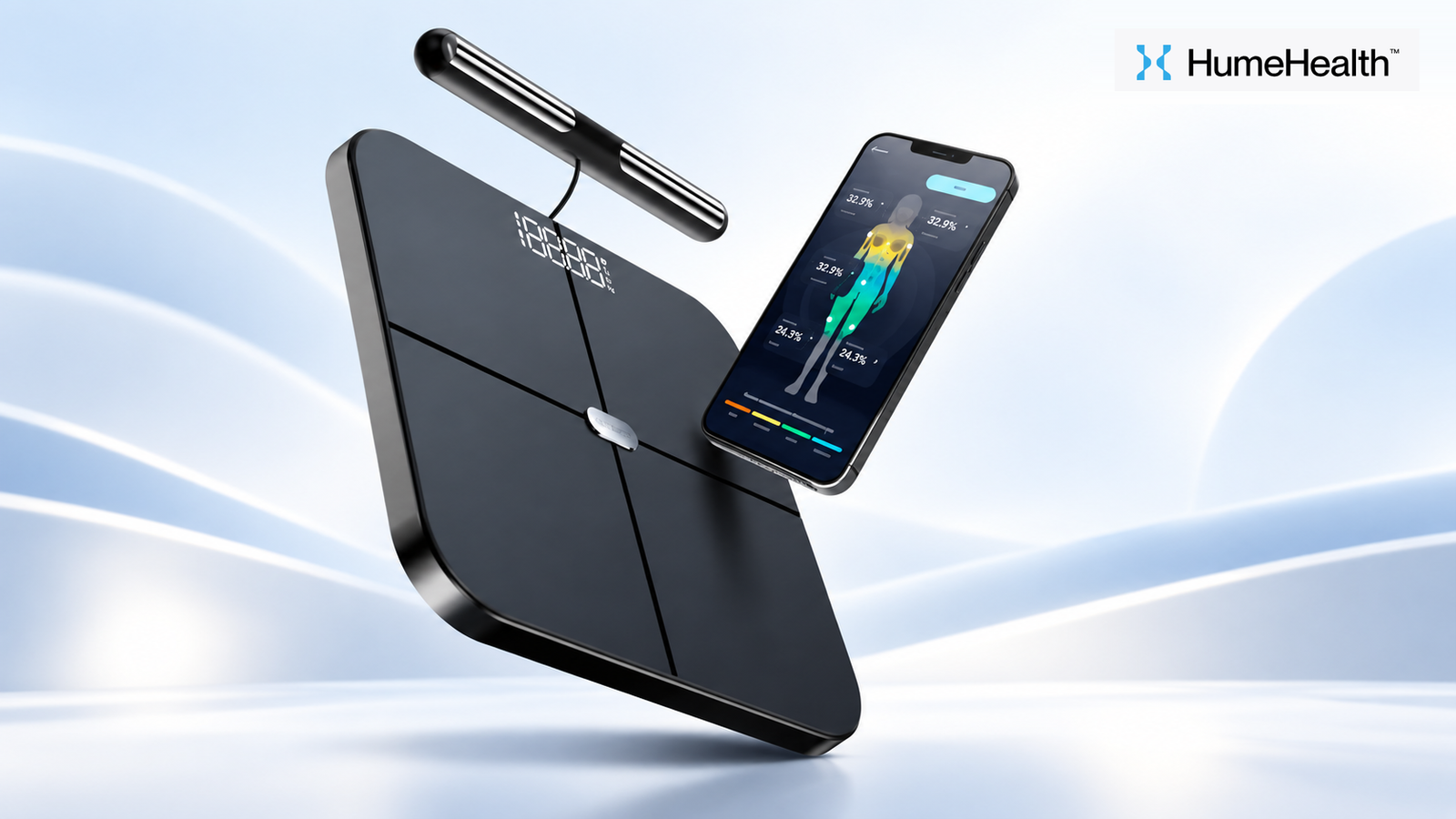
The Hume Pod is Hume Health’s at-home body composition scale. It measures weight and uses bioelectrical impedance analysis (BIA) to estimate body fat, fat mass, lean mass and other body metrics. Its handheld sensors collect readings from the upper body as well as the feet, giving it a broader measurement approach than a basic foot-only smart scale.
Hume promotes the Pod’s results as closely aligned with DEXA scans. But how close are they in practice? Recent independent research offers some evidence, while also showing why users should interpret the Pod’s body fat readings as estimates rather than exact measurements.
How the Hume Pod estimates body fat
The Hume Pod sends a small electrical current through the body and measures how easily that current travels through different tissues. The device combines those readings with details such as height, age and sex to estimate body composition.
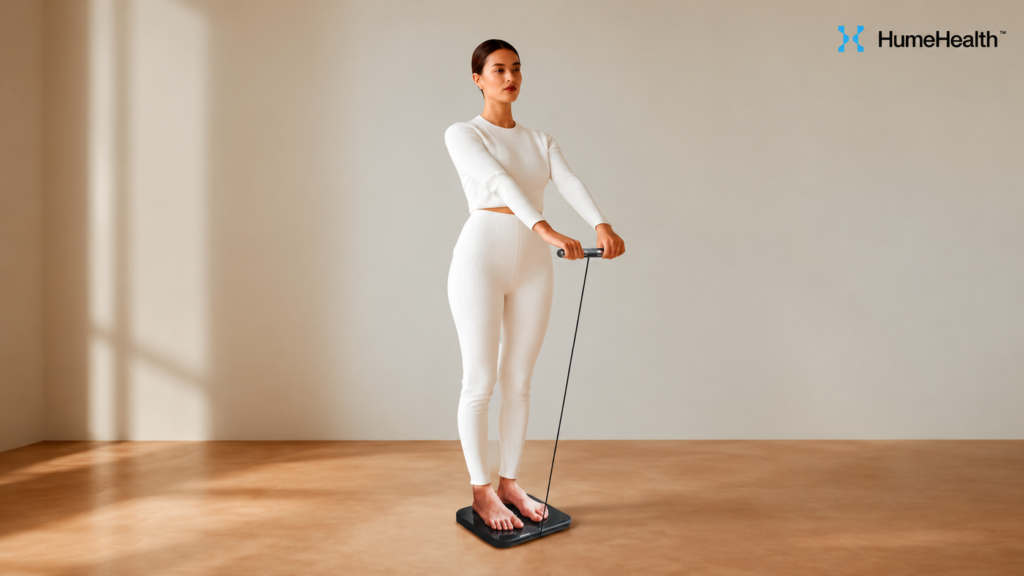
The Pod reports estimates for metrics including body fat percentage, fat mass, lean mass and body water. The handheld sensors are designed to capture information from the arms and upper body, while the platform measures through the feet. Hume says the device provides more than 40 body composition and wellness metrics through its app.
These metrics are calculated from electrical signals and an algorithm. The Pod does not directly scan or photograph body fat. This distinction matters because BIA readings can be affected by hydration, food, exercise and other changes in the body.
The Hume Pod and DEXA: what does “accuracy” mean?

DEXA, short for dual-energy X-ray absorptiometry, uses low-dose X-rays to estimate body fat, lean mass and bone mineral content. Hume has advertised a strong correlation between the Pod and DEXA. A high correlation means that two measurement methods tend to move in the same direction across a group of people. It does not necessarily mean their readings match exactly for each person.
For example, the Hume Pod and DEXA could both show that body fat is lower for one participant than another, while still giving different body fat percentages for the same individual. Correlation is useful, but it is not the same as agreement.
What independent research says about the Hume Pod
A 2026 study evaluated the Hume Pod in 67 adults, comparing its body composition estimates with DEXA and a four-compartment model. The researchers found that repeated Hume Pod measurements taken during the same visit were highly consistent. They also reported strong agreement between the Pod and the four-compartment model.
The DEXA comparison was more mixed. The Hume Pod and DEXA results were strongly correlated, but the average body fat and fat mass estimates differed between the methods. The Pod’s average body fat estimate was lower than DEXA’s in this study, and the researchers reported an average absolute error of about three percentage points for body fat percentage.
That does not mean the Hume Pod will be off by exactly three percentage points for every person. It describes the average difference in this study group. Individual results may vary.
There are also limitations to consider: the study included 67 adults, and the paper was posted as a preprint, which means it had not yet completed peer review when published. The results provide useful early evidence, but they do not establish that the Hume Pod will match DEXA for every user or body type.
Why Hume Pod readings may change
The Hume Pod relies on BIA, and electrical conductivity changes with the body’s water levels. A reading taken after exercise, a meal or a change in hydration may differ from one taken under your usual conditions. These short-term shifts do not necessarily indicate a real change in body fat or muscle.
For more consistent tracking, use the Hume Pod under similar conditions each time:
- Measure at roughly the same time of day.
- Follow Hume’s instructions for barefoot use and holding the sensors.
- Keep the scale on a hard, level surface.
- Avoid comparing a post-workout reading with one taken before exercise.
- Look at trends over several weeks instead of focusing on one result.
A consistent routine can make the Pod’s data easier to interpret, although it cannot eliminate all measurement variation.
How to use Hume Pod results
The Hume Pod is most useful as a home tracking tool. Its measurements may help you see whether body composition estimates are moving in a general direction over time – for example, during a fitness or weight-management plan.
A single Hume Pod reading should not be treated as an exact body fat measurement, a diagnosis or a replacement for a professional assessment. Metrics such as visceral fat, metabolic age and muscle mass are also estimates. If you need body composition information for a medical or clinical decision, speak with a healthcare professional about appropriate testing.
The takeaway
The Hume Pod provides more detailed body composition estimates than a basic weight scale, and early independent research shows encouraging repeatability and strong correlations with reference methods. However, the same study found differences between the Pod and DEXA readings, especially for body fat percentage and fat mass.
Use the Hume Pod to follow consistent trends over time, rather than expecting every result to match a DEXA scan exactly. Its readings can offer useful context about progress, but they remain estimates with limits.