

Personalised health tracking is changing how people think about everyday wellbeing. Instead of relying on occasional check-ins or a single daily number, wearable devices can collect health-related data over time and show how patterns change. Hume Band, from Hume Health, is designed to track a range of signals around the clock and present them through the Hume Health app.
The idea is simple: when people can see patterns in their sleep, activity and recovery, they may find it easier to understand how daily routines relate to how they feel. A wearable cannot make health decisions for someone, but it can provide information to discuss with a healthcare professional or use when reflecting on personal habits.
What is personalised health tracking?
Personalised health tracking uses information collected over time to show an individual’s patterns. Rather than comparing every reading with a general target, users can look at changes in their own data for example, how sleep or resting heart rate varies from their usual range.
This context matters because people have different routines and baselines. A late night, a demanding workout or a change in schedule may affect how someone feels the next day. By tracking several signals together, a wearable may help users notice trends that are difficult to recall from memory alone.
Hume Health positions Hume Band around this longer-term view. Its product information describes tracking measures such as heart rate, heart rate variability (HRV), sleep stages, blood oxygen, skin temperature, activity and recovery. Hume Band 2.0 also offers blood-pressure trend insights, which the company describes as relative trends rather than cuff readings.
How Hume Band fits into a daily routine
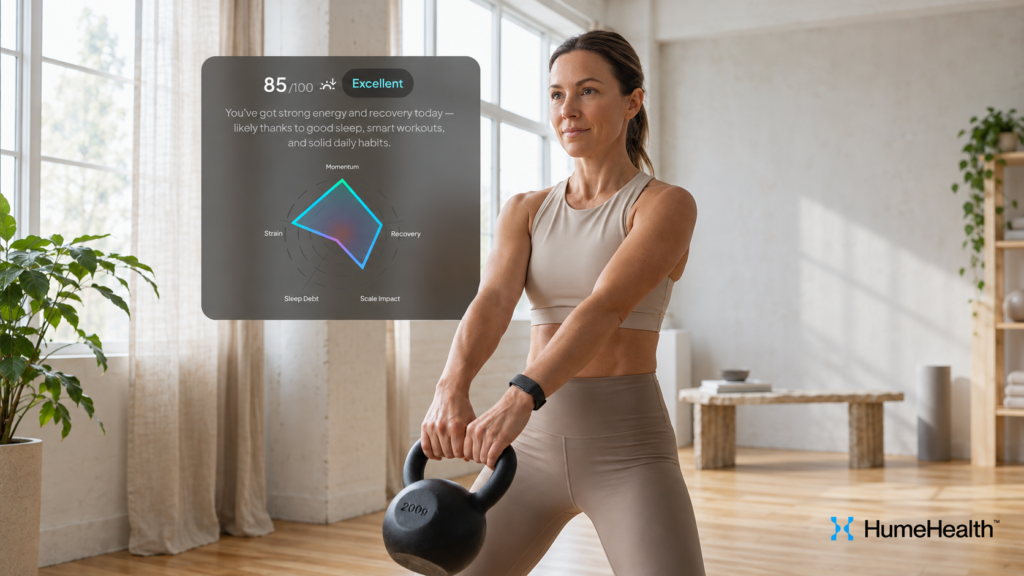
Hume Band is a screenless wearable intended for ongoing use. The company says it can track data throughout the day and night and offers up to 14 days of battery life per charge. Users pair the band with the Hume Health app to view their data and trends.
A typical routine might involve wearing the band during everyday activities and sleep, then checking the app to review recorded information. Over time, a user may be able to compare nights of sleep, changes in activity or recovery scores across different days. This can make the data more useful than a one-time reading, because a pattern develops gradually.
Hume Health also highlights summary measures in its app, including Health Score, Metabolic Capacity and Metabolic Momentum. These are intended to make selected trends easier to interpret. As with any app-generated score, it is helpful to understand what a measure represents and to treat it as a wellness indicator rather than a medical conclusion.
From raw readings to understandable trends
Wearables can collect a lot of information, but numbers alone may be difficult to interpret. Hume Health says the Hume Health app presents tracked signals alongside summaries and insights, helping users explore how their data changes over time.
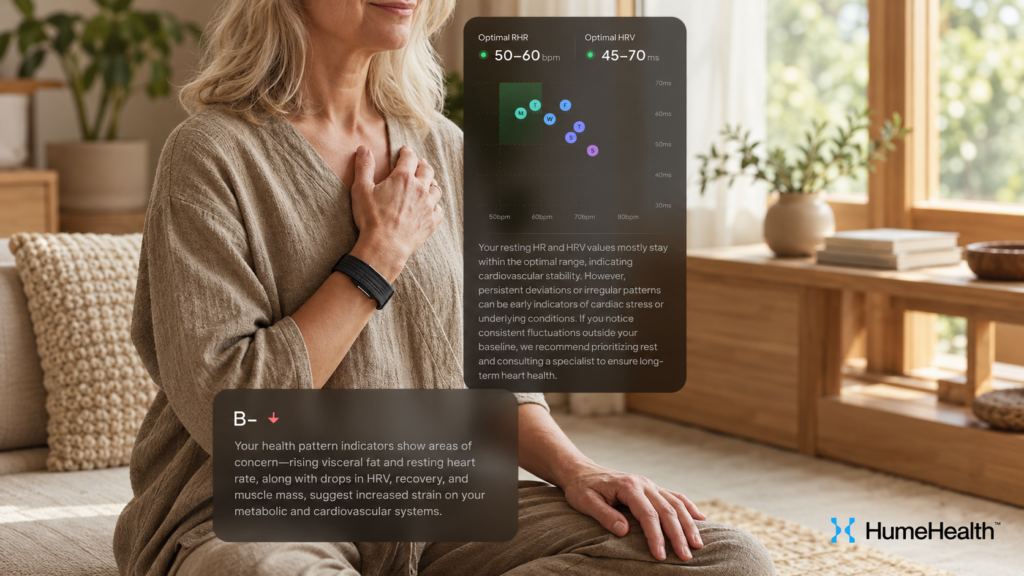
For example, HRV is a measure of variation between heartbeats, and overnight HRV can be one data point users follow alongside sleep and activity. Sleep tracking may estimate time spent in light, deep and REM stages. Activity and strain features can offer a view of movement and exertion during the day.
These measures are most useful when viewed as trends. A single night of sleep data or one unusual reading should not be treated as a diagnosis. Factors such as device fit, movement, routine and individual differences can affect wearable readings. Users should seek advice from a qualified healthcare professional if they have health concerns.
Blood-pressure trends: an important distinction
One feature listed for Hume Band 2.0 is blood-pressure trend insight. Hume Health describes this as a relative trend based on patterns over time, not as a direct cuff measurement. The company says it does not replace a blood-pressure cuff.
That distinction is important for anyone considering a wearable for health tracking. A trend feature can be part of a broader wellness picture, but it should not be used to diagnose or manage high blood pressure. People who need blood-pressure readings should use an appropriate validated monitor and follow advice from a healthcare professional.
Why people are interested in wearable health data
Interest in personalised health tracking is growing because people want practical ways to understand their routines. A wearable can reduce the effort involved in remembering when they slept poorly, how active they were or whether a change in schedule coincided with a change in how they felt.
For some users, seeing a pattern may encourage small experiments: keeping a consistent bedtime, adding gentle movement or allowing more time to recover after demanding activity. The value is in observing whether a routine change appears alongside a change in the person’s own data—not assuming that the wearable has established cause and effect.
Hume Band is one example of this approach. By combining ongoing tracking with app-based summaries, Hume Health aims to make personal health data easier to review. Users can explore their own trends and decide which habits they want to pay attention to.
Choosing a health-tracking wearable
Before choosing a wearable, it helps to think about what information you want to follow and how you will use it. Consider whether you want sleep and activity tracking, how often you are comfortable charging a device, and whether you prefer a screenless design. Also check which app features are included and whether any require a paid membership.
With Hume Band, Hume Health says core metrics are available in its app, while some AI-driven coaching features may be offered as an upgrade. Product features and membership terms can change, so it is sensible to check the latest details directly with Hume Health before buying.
Hume Band and the future of personalised tracking
Personalised health tracking is about building a clearer picture over time. Hume Band brings together continuous wearable tracking and app-based summaries, giving users a way to review measures such as sleep, HRV, activity and recovery. Hume Health’s approach centres on helping users follow their own trends and connect those trends with everyday routines.
The best use of a wearable is as a source of information, not a substitute for medical care. By treating its data as a guide to personal patterns and understanding the limits of each metric users can make more informed decisions about what to discuss with a healthcare professional and which everyday habits they may want to review.